
What Progressive Lenses Cost in Edmonton: $350 One Pair, $500 Two
What Progressive Lenses Cost in Edmonton: $350 for One Pair, $500 for Two
Progressive lenses at Charm Optical in south Edmonton are $350 for one complete pair, frame and lenses together, or $500 for two pairs instead of the regular $700. That covers premium progressive lenses and a coating, so the thing you are really choosing is the lens design, and that is what the rest of this page is about.
That is the answer. The rest of this page is about the part nobody prices for you: which design you actually need, and why a bargain progressive can be perfect for driving and useless at your desk.
What do progressive lenses cost in Edmonton?
A complete progressive pair at Charm Optical is $350. That is one price covering the frame, premium progressive lenses and a coating. A second complete pair takes the total to $500, against a regular price of $700.
Posted prices, Charm Optical
All figures CAD, current as of this article. Complete pair means frame and lenses together, not lenses alone.
- Progressive glasses, one complete pairFrame + premium progressive lenses + coating $350
- Progressive glasses, two complete pairsRegular $700 — a saving of $200 $500
- Single vision glasses, one complete pairFor comparison: one distance only prescription $99
- Photochromic added during manufacturingLenses that darken outdoors, no extra wait — quoted with your prescription Ask us
- Adult eye exam, if AHCIP does not cover youYou need a current prescription before lenses are ordered $99
- Turnaround on a progressive orderCustom ground to your measurements 5–10 days
Progressive pricing sits alongside the single vision packages on the Charm deals page, and the fitting process, the two lens brands we stock and the turnaround are all set out on our progressive lenses page.
Now the part that explains why two progressives can be built to very different standards. Five lens makers dominate the market, they each surface a progressive their own way, and Charm's progressive lens page sets out which two of them we stock. We do not publish other retailers' prices, so treat the lens brand as a question about how the lens is made, and ask us what your own prescription costs.
| Lens brand | Made in | Key technology | At Charm Optical |
|---|---|---|---|
| HOYA | Japan + Vietnam | Dual-surface grinding | Stocked |
| Riverside | Calgary, Alberta | Surface optimization | Stocked |
| Essilor (Varilux) | France + Thailand | W.A.V.E. wavefront | Not stocked |
| Nikon | Japan | SeeMax 8-axis | Not stocked |
| Zeiss | Germany + Hungary | i.Scription precision | Not stocked |
Swipe the table sideways
What are you actually paying for in a progressive lens?
One thing, mostly: how wide the clear part is.
A progressive has no line because there is no join. The power slides from your distance prescription at the top of the lens to your reading prescription at the bottom, down a narrow channel called the corridor. Either side of that corridor the lens cannot be clear, because the power is in the middle of changing. That is optics, not a fault.
Lens designers get to choose how to spend that unavoidable blur, and a 2021 study in Scientific Reports states the trade plainly:
“Soft designs have a smoothly varying optical blur across the lens surface, which is traded off by a narrower area providing clear vision (progressive corridor), whereas hard designs provide a larger area for clear vision at the cost of an abrupt change in refractive powers into the distorted region.” De Lestrange-Anginieur & Kee, Scientific Reports (2021)
Spend more and you are buying your way out of that trade rather than choosing a side of it. Modern lenses are surfaced digitally, point by point, instead of pressed from a mould. A 2026 review in Cureus of freeform against aspheric lenses reports that freeform progressives “offer wider corridors, larger reading zones, smoother progression, and also a significant reduction of peripheral blur (‘swim effect’) compared to traditional or aspherically-designed PAL design”, and that they represent “the bulk of the premium PAL market” (Ladopoulos, Pateras & Ninos, 2026).
Both progressive designs Charm stocks are dual-surface, meaning the prescription is worked into the front and the back of the lens rather than the front alone.
| Lens design | Corridor (the middle band) | Reading zone | Peripheral blur / swim |
|---|---|---|---|
| Conventional or aspheric | Narrowest — the desk band goes first | Smallest | Most noticeable at the edges |
| Standard freeform | Wider, usable at a screen | Larger | Reduced, smoother onset |
| Personalised freeform | Widest, cut to your own measurements | Largest | Significantly reduced |
Swipe the table sideways
Why does a budget progressive fail at your desk?
Because the corridor is narrowest exactly where the power is changing, and that is the part of the lens you look through at a monitor. Distance is fine. Reading a phone is fine. The spreadsheet is where a narrow design shows.
So here is that lens, from the inside. Three real tasks at three distances, seen through one progressive. Change the design, then change the fitting, and watch which row survives.
Three tasks, one lens, one clear band each
The tinted stripe is the width of clear vision for that task. Words outside it are what your eye actually receives.
Road sign — farComfortable
ELLERSLIE RD SW — EXIT 500 m — SPEED 60
Monitor — arm's lengthNarrow band
column K does not match the invoice total
Small print — readingComfortable
olive oil, sea salt, 1 tsp baking soda, 2 eggs
Distance and print are easy. The screen works, but the clear band is narrow enough that you will centre your head on it.
Head movement: small head turns to follow a line across the screen.
Schematic. It shows the direction and the relative size of the difference between designs and between fittings, not a measured lens map — corridor width is not published as a single number and depends on your prescription, your add power and your frame. Charm stocks two dual-surface designs, HOYA and Riverside; either way the complete pair is $350.
The second control is not a hypothetical. A progressive only works if the corridor is placed where your eyes already travel, and that is decided by four measurements taken on your face in the frame you have chosen: pupillary distance, segment height, vertex distance and frame tilt. Charm's progressive lenses page puts the tolerance bluntly: even 1mm off can make progressives uncomfortable.
The Cureus review agrees, and goes further. It reports that the loss of benefit from a freeform lens “can be attributed exclusively to measurement error in one or more of the fitting parameters (monocular PD, fitting height, vertex distance, pantoscopic tilt, face form)”. In other words: the better the lens, the more the fitting matters. Paying up for a premium design and then having it fitted from a guess spends money on nothing.
Why we do not sell progressives online
Single vision lenses can be ordered from a prescription alone. Progressives cannot, because segment height is a measurement of where your pupil sits in one specific frame. Browse the frames online, then come in for the fitting. If you need a pair fast, same-day single vision is the option that moves quickly — a progressive order takes about 5 to 10 business days.
Does the frame change what progressives cost?
A complete progressive pair at Charm starts at $350. Which frame you put those lenses in is a fitting question first, and a pricing question we would rather answer out loud than in a table — tell us the frame you like and we will tell you what that pair comes to. What the shape decides is whether the lens works at all.
A progressive needs vertical room underneath your pupil for the corridor and the reading zone to fit. A deep front gives an optician that room. A very shallow front leaves the reading zone competing for space with the bottom of the eyewire, which is when people start tipping their head back to read. Depth is measured on the actual frame, never guessed from a picture, so this is a conversation at the counter rather than a rule.
-

Momono
Round · eye 49 · bridge 20
A round front is usually the deepest shape for its eye size, which is why opticians reach for it first on a strong add.
-

Oakley
Square · eye 55 · bridge 16
A big square front gives plenty of depth, and a wide front also gives the corridor room to sit where your eyes converge.
-

Ray-Ban
Rectangle · eye 54 · bridge 18
Rectangles are the shape to check, not the shape to avoid. Some are deep, some are shallow, and the only way to know is to measure it.
Three frames from the Charm shelf, picked to show how differently a front can sit — not to compare prices, which is why none are shown here. Shape, eye size and bridge are the published measurements on each product listing; the vertical depth that matters for a progressive is measured in store, on the frame you pick, and we will quote that frame with progressive lenses in it while you are standing there.
Do you need high-index lenses in a progressive?
Sometimes. A progressive stacks reading power onto your distance prescription, so a strong prescription is being asked to do two jobs in one piece of plastic, and the edges get thick and heavy. A thinner high-index material buys back the weight and the edge, and on a rimless or a drilled frame it can be the difference between wearable and not.
It is a separate decision from the progressive design, and it is priced against your prescription rather than off a list, which is why we quote it once we have seen the numbers. Our guide to whether thinner lenses are worth the price covers where the money is well spent. If you want the full line-by-line anatomy of a glasses invoice, that lives in how much prescription glasses cost in Canada.
How long do progressive lenses take to get used to?
Charm's progressive lenses page puts adaptation at 3 to 7 days of full-time wear. In the first few days you may notice soft focus at the edges and a habit of turning your head instead of moving your eyes. The advice that matters is to wear them all day rather than switching back and forth, because the brain adapts to one consistent input faster than two.
Design helps here too. The Cureus review reports that freeform lenses are associated with “shorter adaptation time”, particularly in first-time progressive wearers and in people moving from a simpler design.
If a pair still feels wrong after two weeks, the usual culprit is the fitting rather than the prescription, and that is fixable. Bring them in.
Is $500 for two pairs worth it?
The second complete progressive pair costs $150 more than the first, against $700 for two bought separately. Whether $150 is a good use of your money depends entirely on whether the second pair does a job the first one cannot.
- A dedicated computer pair. The strongest case, and it follows directly from the desk row above. A pair set up for one working distance has no corridor to hunt for.
- Prescription sunglasses. Progressive sunglasses mean you stop swapping at the door and stop reading a phone in the sun through the wrong lens.
- A genuine spare. If you cannot legally drive without your glasses, a backup in the car is not a luxury.
- A second pair to sit in a drawer. Not worth $150. One properly fitted pair beats two compromises.
If a benefits plan is covering part of this, we direct bill plans including Alberta Blue Cross, Canada Life (formerly Great-West Life), Desjardins, AISH and Alberta Works, so you pay the balance rather than the whole invoice and claim it back. Call us with your plan details before you choose, not after.
One honest note about claiming
Two pairs on one invoice is a normal, legitimate purchase. What is not legitimate is an invoice that describes something other than what was dispensed, or the same dollar claimed twice. If you are unsure where a line sits, ask us and we will tell you plainly. Our 16-question quiz on telling real benefits fraud from the myths is a quick way to test what you think you know.
Progressive lens FAQ
How much do progressive lenses cost in Edmonton?
Progressive glasses at Charm Optical are $350 for one complete pair, which includes the frame, premium progressive lenses and a coating, or $500 for two complete pairs instead of the regular $700. A strong prescription, a designer frame or an add-on such as photochromic will move the total, so call (780) 490-0090 and we will price your exact prescription.
Why are progressive lenses more expensive than single vision?
A progressive lens is not one prescription. It is a gradient from your distance power at the top of the lens to your reading power at the bottom, down a narrow corridor. That takes more surfacing work, a longer manufacturing run of 5 to 10 business days, and four extra measurements taken on the frame you actually buy. For comparison, a complete single vision pair at Charm Optical is $99 and a complete progressive pair is $350.
Are cheap progressive lenses worth it?
A lower cost progressive saves money on the lens design, and the first thing a narrower design gives up is the middle of the lens, which is the part you use for a computer screen. A 2021 study in Scientific Reports describes the trade directly: soft designs spread the blur out but leave a narrower area of clear vision, while hard designs give a larger clear area with an abrupt change beside it. If most of your day is at a desk, that middle band is the part worth paying for.
What is the corridor in a progressive lens?
The corridor is the narrow vertical channel down the middle of the lens where the power changes from your distance prescription to your reading prescription. Either side of it the lens cannot be clear, because the power is in the middle of changing. A wider corridor is the main thing you buy when you move up a design. A 2026 review in Cureus reports that freeform progressives offer wider corridors, larger reading zones and a significant reduction of peripheral blur compared with traditional designs.
How long does it take to get used to progressive lenses?
Most people adapt within 3 to 7 days of full-time wear. In the first few days you may notice soft focus at the edges and a habit of turning your head instead of moving your eyes. Wear them all day rather than switching back and forth, because your brain adapts faster to one consistent input. If they still feel wrong after two weeks, bring them in and we will recheck the measurements.
Can I buy progressive lenses online?
Charm Optical fits progressive lenses in store only, because a progressive needs measurements taken on your face in the frame you have chosen: pupillary distance, segment height, vertex distance and frame tilt. Even 1 mm off on the segment height puts the reading zone somewhere your eyes do not naturally travel. You can browse the frames online and then come in for the fitting.
Does insurance cover progressive lenses in Alberta?
Alberta Health Care does not cover eyewear, so progressives are paid for by a private or group plan, or out of pocket. Charm Optical direct bills plans including Alberta Blue Cross, Canada Life (formerly Great-West Life), Desjardins, AISH and Alberta Works, so you pay only the balance your plan does not cover. Call (780) 490-0090 with your plan details and we will check what is covered before you choose a frame.
How long do progressive lenses take to make?
About 5 to 10 business days, because each lens is custom ground to your measurements. That is why progressives are not a same-day product the way single vision often is. Photochromic or a blue light filter can be added during manufacturing without adding to the wait.
Get your number
Call (780) 490-0090 and we will price your exact prescription.
Bring your prescription, or your last pair, and we will tell you what a complete progressive pair costs for your numbers — including whether you need a thinner material, and which frames on the shelf have the depth for your add.
Charm Optical Inc., 5035 Ellerslie Rd SW, Edmonton. By appointment — visit us. Prices are current as of publication and are for a complete pair, frame and lenses together.
Prescription out of date?
Lenses are only as good as the numbers behind them.
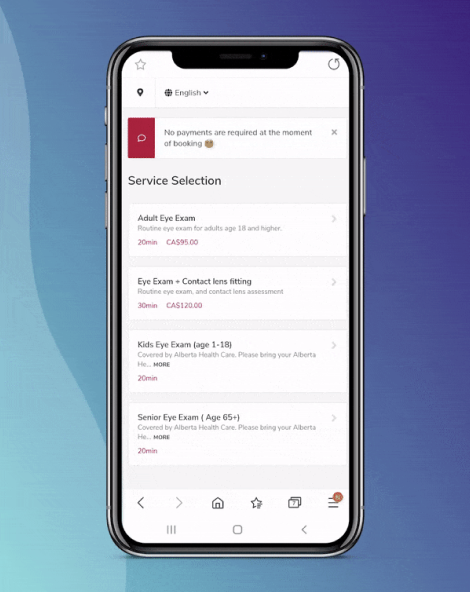
A progressive is built from a current prescription and a current add power. An adult comprehensive eye exam is $99 if AHCIP does not cover you, and appointments can be booked online.
Related reading: single vision or progressive — which do you need · progressives vs bifocals · current glasses pricing