
How Often Do You Really Need an Eye Exam? By Age, 0 to 80+
How Often Do You Really Need an Eye Exam? By Age, 0 to 80+
Every two years is the baseline for healthy adults aged 20 to 64. Children 6 to 19 and adults 65 and older should go every year. Babies get a first exam at six to nine months. That is the Canadian Association of Optometrists schedule for low-risk people, and one risk factor is enough to shorten it.
That is the whole answer. The rest of this page is the detail: what happens in each age band, which risk factors actually shorten your interval, what Alberta Health pays for, and how to tell when you are genuinely due rather than guessing.
How often should you get an eye exam?
The reference schedule in Canada comes from the Canadian Association of Optometrists position statement on the recommended frequency of the comprehensive eye examination, reviewed July 2024. It reads as five rows. Note the heading on its own table: these are the intervals for low-risk, asymptomatic individuals.
| Age group | Recommended interval | What the exam is looking for |
|---|---|---|
| Infants and toddlers, birth to 24 months | One exam at 6 to 9 months | Eye alignment, equal focus between the two eyes, anything structural |
| Preschool, 2 to 5 years | At least one exam | Lazy eye, turned eye, uncorrected long-sightedness, before school starts |
| School age, 6 to 19 years | Annually | Prescription change, myopia progression, focusing and eye-teaming problems |
| Adults, 20 to 64 years | Every two years | Prescription drift, eye pressure, retinal health, early signs of systemic disease |
| Adults, 65 years or older | Annually or as recommended | Cataract, glaucoma, macular change, contrast and driving vision |
The 2024 statement is blunt about the limit of any table: it recommends these intervals for healthy individuals, and says the frequency of examinations for high-risk and symptomatic patients "can only be determined by the treating clinician." So the table is a floor, not a ceiling.
Build your own schedule
Here is the same schedule as a life, not a table. Each tick is one eye exam. Set your age, then tick anything that applies to you and watch what happens to the middle of the ribbon.
The lifetime exam ribbon
The gap in the middle of the ribbon is the 45 years when a healthy adult is only seen every second year. Risk factors close that gap.
0-52 exams 6-19yearly 20-64every 2 yrs 65-85yearly
Your interval
Every 24 months
Low-risk adults aged 20 to 64 are seen every second year. Tick a risk factor above to see it change.
32 exams between now and 80
AHCIP does not insure routine exams from 19 to 64. A comprehensive exam at Charm Optical is $99.
Counts are arithmetic on the Canadian Association of Optometrists schedule, not a diagnosis. Only the optometrist who examines you can set your interval.
Why is the adult default two years, not one?
Because between 20 and 64, in a healthy eye with no risk factors, two years is short enough to catch the things that change slowly and long enough not to waste anybody's time. Prescriptions drift. Eye pressure creeps. Retinas change quietly. None of that moves fast enough in a low-risk 30-year-old to need a yearly look.
The reasoning behind the schedule is worth reading, because it explains why the interval exists at all:
A comprehensive eye examination is the best tool for the early detection of eye disease and several systemic diseases. It is based on the premise that structural change in the eye (often at the microscopic level) manifests itself well before any functional changes and vision loss occur. Canadian Association of Optometrists, Recommended Frequency of the Comprehensive Eye Examination, reviewed July 2024
The same statement estimates that if exams are performed on the recommended schedule, with diagnostic and imaging tools, more than 90% of vision loss in Canada can be detected early and stopped before it becomes functional impairment. The interval is the mechanism. Skipping it is what breaks it.
Which risk factors shorten your interval?
This is the part most articles skip. The two-year default belongs to a specific person: an adult with no eye disease, no relevant family history, no systemic disease affecting the eye, and no symptoms. Take any one of those away and the interval usually shortens. Here is what moves it, factor by factor, and where the recommendation comes from.
| Risk factor | Why the interval shortens | Interval it points to |
|---|---|---|
| Type 1 diabetes | Diabetes Canada: screen annually, starting five years after onset, in people aged 15 and older | Every 12 months |
| Type 2 diabetes | Diabetes Canada: screen at diagnosis; with no or minimal retinopathy the recommended interval is one to two years, tailored to severity | Every 12 to 24 months |
| Glaucoma in a parent or sibling | The Canadian Association of Optometrists lists family history of glaucoma and increased age among the risk factors, and says people with early stage glaucoma are often not aware of it themselves. It recommends routine eye exams to screen for it, without naming an interval | Set by your optometrist |
| High myopia | CAO: myopia greater than -7 dioptres puts a person at risk of retinal detachment and myopic macular degeneration, and "if high myopia is diagnosed, the recommendation is to have more frequent eye examinations (for example, every six months)" | Every 6 to 12 months |
| Full-time contact lens wear | In practice, not from a published interval: a lens sits on the cornea all day, so fit and front-of-eye health need rechecking, and the contact lens prescription carries its own expiry date | Every 12 months |
| Past eye injury, eye surgery, or long-term steroid use | CAO: the frequency of examinations for high-risk and symptomatic patients can only be determined by the treating clinician | Set by your optometrist |
| Screen-heavy work, 6+ hours a day | In practice, not from a published interval: digital eye strain is a symptom cluster, not a disease. It does not shorten a healthy adult's routine interval. It lowers the threshold for booking when symptoms persist | Book on symptoms, not the clock |
The screen myth
Long screen days do not damage the eye, and they are not a reason to move to an annual exam on their own. What they do is make an uncorrected prescription, a dry eye, or a focusing problem impossible to ignore. If your eyes ache by mid-afternoon, that is a booking trigger now, not a note for your next scheduled visit.
What happens in each age band
Birth to 5: two exams before school
The first comprehensive exam belongs between six and nine months of age, and at least one more between two and five. A baby cannot report blur, and a preschooler assumes everyone sees what they see. Both exams are looking for alignment, a large difference in focus between the two eyes, and anything structural. Catching a turned or lazy eye early is the single strongest argument for the infant visit, because the treatment window closes as the visual system matures.
6 to 19: yearly, without exception
Annual is the recommendation for the entire school-age range, and this is the band where the CAO's own research is most pointed. Work from the University of Waterloo's School of Optometry and Vision Science with the CNIB Foundation found myopia in children rises sharply from Grade 1 to Grade 8, with almost a third of cases going undiagnosed and uncorrected, and the onset of myopia now falling at 6 to 7 years of age where it used to begin at 12 to 13. A child who reads the board fine in September may not in March. See myopia control for what can be done about progression, and kids' glasses for what happens after the exam.
20 to 64: every two years, unless something says otherwise
This is the long, quiet middle of the ribbon, and it is where most people fall out of the habit. Nothing hurts, the phone is still readable, and four years pass. In practice the two-year interval holds only while you stay in the low-risk group described above. Pregnancy, a new diabetes diagnosis, a change in medication, a first pair of contact lenses, or a parent diagnosed with glaucoma all reset the clock.
65 and older: back to annual
The interval tightens again at 65 because the things it is screening for stop being rare. Cataract, glaucoma, and macular change all become more common with age, and the functional consequences, especially for driving at night, arrive before the person notices a change in the letters on the chart. The CAO wording here is "annually or as recommended," which is a deliberate opening for your optometrist to see you more often.
Does AHCIP cover eye exams in Alberta?
Partly, and the boundary is by age. Alberta Health states that children 18 years old and younger, and seniors 65 years and older, are eligible for one oculo-visual assessment, meaning a complete routine eye exam, and one diagnostic procedure per benefit year, which runs 1 July to 30 June. Routine eye exams for residents aged 19 to 64 are not insured. Medically necessary eye care for specific medical conditions treated by optometrists is covered at any age.
In plain terms: if you are 19 to 64 and healthy, your routine exam is yours to pay for or claim on a benefits plan. At Charm Optical in south Edmonton, a comprehensive eye exam is $99. A contact lens exam and fitting is $135, and it is a separate service, not an add-on inside the $99. Exams are by appointment.
If you wear contacts
A contact lens prescription is a separate prescription with its own expiry, which is what quietly forces most full-time wearers onto a yearly visit. The fitting checks the curve, the diameter, and how the front of the eye is coping with a lens on it all day. Details on contact lens fitting in Edmonton.


What if you see fine and feel fine?
Then you are exactly the person the schedule was written for. The whole premise of an interval is that the eye changes structurally before you notice anything functionally.
Glaucoma is the clearest case. An analysis of the 2016 to 2019 Canadian Health Measures Survey published in the Canadian Journal of Ophthalmology found that 37.5% of Canadians with definite glaucoma were unaware they had it. It does not hurt, it takes peripheral vision first, and the brain fills in the missing field so convincingly that people drive for years without knowing. It is picked up on a routine exam or not at all. More on what that exam looks for on our glaucoma page.
Diabetes works the same way from the other direction. Diabetic retinopathy is graded before it is felt, which is why Diabetes Canada ties screening to the diagnosis date rather than to symptoms: annually for type 1 from five years after onset in those 15 and older, and from the moment of diagnosis for type 2, at one to two years while retinopathy is absent or minimal. See our diabetic eye exam page for what the appointment involves.
The CAO puts the general version of this bluntly: waiting for obvious symptoms before booking an eye examination "exposes the patient to significant unnecessary risk."
How do you know you are actually due?
Most people guess, and most people guess late. Three reliable checks, none of which require you to remember anything:
- Read the date on your prescription. Your glasses or contact lens prescription carries an issue date. If it is more than two years old and you are an adult, you are due. If it is more than one year old and you are under 19, over 64, or on the risk list above, you are due.
- Check the benefit year, not the calendar year. Alberta's AHCIP benefit year runs 1 July to 30 June. Many private plans run on a January to December or a plan-anniversary cycle. Booking a month before your own year end is how coverage stops expiring unused.
- Treat any change as an override. New floaters or flashes, a sudden change in one eye, headaches tied to reading, or difficulty with night driving are all reasons to be seen now, whatever the interval says.
FAQ
How often should you get an eye exam?
For low-risk adults aged 20 to 64, the Canadian Association of Optometrists recommends a comprehensive eye exam every two years. Children aged 6 to 19 and adults 65 and older should go annually. Any significant risk factor, such as diabetes or high myopia, shortens that interval, and the CAO says the frequency for high-risk patients can only be determined by the treating clinician.
Is an eye exam every year or every two years?
Both are correct, for different people. Every two years is the baseline for healthy, symptom-free adults aged 20 to 64. Every year is the baseline for children 6 to 19, for adults 65 and older, and for anyone at higher risk at any age. Your optometrist sets your interval at the end of the exam.
When should a baby have a first eye exam?
Between six and nine months of age. The Canadian Association of Optometrists recommends the first comprehensive eye examination in that window, then at least one more exam between the ages of two and five, before school starts.
Does AHCIP cover eye exams in Alberta?
Alberta Health says children 18 and younger and seniors 65 and older are eligible for one routine eye exam per benefit year, which runs 1 July to 30 June. Routine exams for ages 19 to 64 are not covered, though medically necessary eye care for specific medical conditions is covered at any age.
How often should someone with diabetes have an eye exam?
Diabetes Canada recommends screening at least annually for people with type 1 diabetes, starting five years after onset in those aged 15 and older. For type 2 diabetes, screening starts at diagnosis, and for people with no or minimal retinopathy the recommended interval is one to two years, tailored to severity.
Do contact lens wearers need an eye exam more often?
In practice, yes. A contact lens prescription is a separate prescription with its own expiry date, and a lens sits on the cornea all day, so the fit and the health of the front of the eye have to be rechecked. Most full-time wearers end up on a yearly visit. At Charm Optical a contact lens exam and fitting is $135, which is separate from the $99 comprehensive eye exam.
I see fine and have no symptoms. Do I still need an eye exam?
Yes. Glaucoma is the clearest example: an analysis of Canadian Health Measures Survey data published in the Canadian Journal of Ophthalmology found 37.5% of Canadians with definite glaucoma were unaware they had it. The Canadian Association of Optometrists warns that waiting for obvious symptoms exposes the patient to significant unnecessary risk.
How much is an eye exam at Charm Optical?
A comprehensive eye exam for an adult who is not covered by AHCIP is $99 at Charm Optical in south Edmonton. A contact lens exam and fitting is $135 and is not included in the $99. Exams are by appointment. You can book at see.charmoptical.ca or call (780) 490-0090.
Book your exam
Work out your interval, then put it in the calendar.
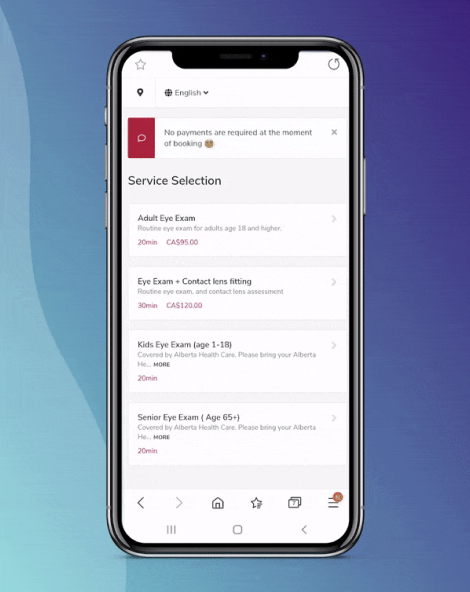
If the ribbon above says you are due, the next step is a comprehensive eye exam at 5035 Ellerslie Rd SW in south Edmonton. $99 for adults not covered by AHCIP, and covered for under-19s and 65-plus under the AHCIP benefit year. Contact lens exam and fitting is $135. By appointment.
Not sure whether your plan covers it? We direct bill where the plan allows. More on the exam itself: eye exams in Edmonton.
Sources:
- Canadian Association of Optometrists, Recommended Frequency of the Comprehensive Eye Examination (position statement, reviewed July 2024)
- Canadian Association of Optometrists, Myopia (position statement)
- Canadian Association of Optometrists, Glaucoma (eye health library)
- Government of Alberta, Health care services covered in Alberta
- Diabetes Canada, Clinical Practice Guidelines, Retinopathy
- Canadian Journal of Ophthalmology, Prevalence of glaucoma in Canada: results from the 2016-2019 Canadian Health Measures Survey