
The Numbers Inside Your Frame: 52-18-140, Explained
The Numbers Inside Your Frame: 52-18-140, Explained
52-18-140 is three measurements in millimetres, stamped inside one temple arm: a 52 mm lens width, an 18 mm bridge, and 140 mm arms. The first two set how wide the front sits — 52 + 18 + 52 = 122 mm across the two lens boxes, with the rims and endpieces adding a few millimetres on top. That total, not any single number, is what makes a frame fit.
Those numbers are not marketing. They come from an international measuring system, and once you can read them you can shop frames anywhere without guessing. Here is what each one measures, where to find it, and the two places it matters most: a strong prescription, and replacing a pair you already love.
What do the numbers 52-18-140 mean?
All three are millimetre measurements of the frame itself, taken the same way by every manufacturer. The system is defined in ISO 8624:2020, Ophthalmic optics — Spectacle frames — Measuring system and vocabulary, which is built on the boxing system: each lens shape is treated as if it sat inside a rectangle, and the rectangle gets measured instead of the curvy lens. The companion standard, ISO 12870:2016, sets the requirements for frames “at the point of sale.”
| Number | What it measures | Typical range | What it changes for you |
|---|---|---|---|
| 1st — eye size (52) | Horizontal width of one lens opening | 40–60 mm | How wide the lenses are, and how thick a strong lens gets |
| 2nd — bridge (18) | Gap between the two lenses, over your nose | 14–24 mm | Where the frame sits on your nose, and how high it rides |
| 3rd — temple (140) | Hinge to the tip of the arm | 120–150 mm | Whether the frame grips behind your ear or slides forward |
← swipe the table →
Ranges are as published by All About Vision: “the eye size (lens width) of most glasses frames is 40 to 60 mm”, “the bridge width of most eyeglass frames is 14 to 24 mm”, and “temple lengths generally range from 120 to 150 mm.” A 52-18-140 stamp sits mid-range on all three, which is exactly why you see it so often.
The boxing system also defines a vertical lens size — the height of that same rectangle. It is rarely stamped, but it is one of the numbers that decides whether a progressive lens has enough depth to work, so an optician will measure it off the frame when it matters.
Where are the numbers stamped?
Look on the inside of one temple arm, near the hinge or near the tip. All About Vision puts it the same way: the measurements “usually appear on the inner surface of one of the frame temples that hold your glasses in place behind your ears.”
Three exceptions catch people out:
- Rimless and thin metal frames often carry the numbers on the bridge instead, printed small enough that you may need your phone camera zoomed in.
- Worn frames lose the print. Ink-filled stamps on acetate rub off after a few years of cleaning cloths.
- Only two numbers sometimes appear — eye size and bridge — with the temple length left off. That is normal on some designer models.
Measure it. Eye size is the widest horizontal span of one lens opening. Bridge is the narrowest gap between the two lenses. Temple length runs from the hinge screw to the very end of the arm, following the bend. A cheap millimetre ruler gets you within about a millimetre, which is close enough to shop with.
Which number decides how wide a frame sits?
Neither one on its own. Add them and you get the span of the two lens boxes: eye size + bridge + eye size. A 52-18 frame spans 122 mm, a 56-18 frame spans 130 mm. The finished frame is a few millimetres wider than either figure, because the rims, endpieces and hinges sit outside the lens boxes — which is why a maker’s stated “total width” never equals the sum of the stamped numbers. The gap between the two frames holds either way: eight millimetres is the difference between a frame that ends at your temples and one that hangs past them.
There is a second sum that matters more, and almost nobody knows it. Eye size + bridge = the frame PD — the distance between the geometric centres of the two lens rectangles. For a 52-18 frame that is 70 mm. This is the number your lenses get centred against.
Two frames can look nothing alike and centre identically. 52-18 and 54-16 are both a 70 mm frame PD.
Is PD part of my prescription?
No, and that surprises people. Your pupillary distance — the gap between the centres of your pupils — is a dispensing measurement, taken when you choose a frame, not a result of the refraction. WebMD states it plainly: your provider “normally measures it for you, but you won’t find it on your prescription.”
It matters because every lens has one optical centre, and that centre has to land in front of your pupil. If the frame PD is 70 mm and your PD is 66 mm, each lens has to be shifted 2 mm inward from the middle of its rectangle. That shift is called decentration, and it is where frame choice starts to fight your prescription.
In Eyecare Business, Alex Yoho, ABOM, gives the working rule: “A good rule of thumb is to select a frame whose PD is within 6mm of the patient’s PD.” The same article gives the reason it matters in the lab: “ED + Total Decentration = Minimum blank size needed to cut the lens shape.” More decentration means a bigger blank, and a bigger blank means a thicker lens.
How do I match a new frame to the pair I already like?
Put both fronts on the same face and look at where each one wants to centre. That is what the bench below does. Type in the numbers stamped in the pair you own, the numbers of the pair you are considering, and your PD if you know it.
Two fronts, one face, drawn to scale
The right half of each front, both drawn to the same millimetre scale. Fronts are symmetrical, so half tells the whole story — and magnified like this you can see the millimetres that decide whether a lens centres properly.
← swipe the diagram sideways →
Your pupil Frame A lens centre Frame B lens centre
Don’t know your PD? Leave 66 mm in place — it is a common adult figure, and the comparison between the two frames still holds. We measure the real one in store.
Frame A — the pair you own
Lens-box span122 mm
Frame PD70 mm
Off your PD by4 mm
Shift per lens2.0 mm
Inside the 6 mm guide — centres easily.
Frame B — the pair you’re eyeing
Lens-box span130 mm
Frame PD74 mm
Off your PD by8 mm
Shift per lens4.0 mm
Past the 6 mm guide — expect thicker outer edges.
The swap: to centre the way your 52-18 does, a 56 eye size needs a 14 bridge. Frame B’s 18 bridge puts its frame PD 4 mm too far out.
The lesson lands fast once you drive it: hold the sum, trade the parts. If you loved a 52-18 and the frame you want has a 56 eye size, look for a 14 mm bridge on it. Same centring, wider lens, different look. Change the eye size without changing the bridge and you push the whole optical layout outward.
Why does a bigger eye size thicken a strong lens?
Because lens curves are not straight lines. The sag of a surface — how far it falls away from flat by the time you reach the rim — grows with the square of the distance from the optical centre. Widen the lens a little and the rim gets thicker rather more than a little. The standard approximation:
y = half the lens width in mm · F = power in dioptres · n = refractive index
Run it at −6.00 D in a 1.60 index lens and the pattern is obvious. This is arithmetic from the formula above, not a quote from a price list:
| Eye size | Half-width (y) | Rim sag | vs a 52 eye size |
|---|---|---|---|
| 46 mm | 23 mm | 2.6 mm | 22% less |
| 50 mm | 25 mm | 3.1 mm | 8% less |
| 52 mm | 26 mm | 3.4 mm | — |
| 56 mm | 28 mm | 3.9 mm | 16% more |
| 60 mm | 30 mm | 4.5 mm | 33% more |
← swipe the table →
Rim sag is not the same as finished edge thickness. Real edge thickness is the sag plus the centre thickness, adjusted for base curve, index and the edging allowance the lab needs. What the table shows is the direction and steepness of the effect: at a strong minus power, going wider costs you disproportionately, and decentration adds to it on the outer edge on top.
Stack the two effects and you get the combination opticians quietly steer people away from: a strong prescription, a wide frame, and a narrow PD. Each one alone is fine. All three together produce a lens with a visibly heavy outer edge, no matter which index you pay for.
Two numbers, then, are the ones to watch if your prescription is strong: keep the eye size modest, and keep the frame PD close to your own PD. That is more effective than any single upgrade on the lens side. If you want to see how lens choices price out alongside the frame, our glasses deals page lists the current packages — single vision starts at $99 for one pair and $159 for two.
Same numbers, different fit
The stamp is a rectangle’s worth of information, and a rectangle cannot describe a shape. All About Vision flags this directly: “two frames with the same frame measurement may fit differently depending on the style and shape of the eyeglasses.” A round 52 and a square 52 fill their boxes very differently, so they sit differently on a face and cut differently in the lab.


Prices as listed on charmoptical.ca. Every model comes in its own set of sizes — check the stamp on the pair you try.
Material changes the maths too. A metal front with adjustable nose pads lets an optician move the frame up or down your nose, which shifts the optical centre vertically without changing a single stamped number. Acetate has a fixed bridge, so it either sits right or it does not. If you want the metal route, our Flexon page is a good place to start.
Bring the pair in and we will read it
The fastest version of everything above takes about two minutes at a counter. Bring the glasses you already wear. We read the stamp, measure your PD properly, and tell you which eye sizes your prescription will tolerate before you fall for a frame that cannot carry it.
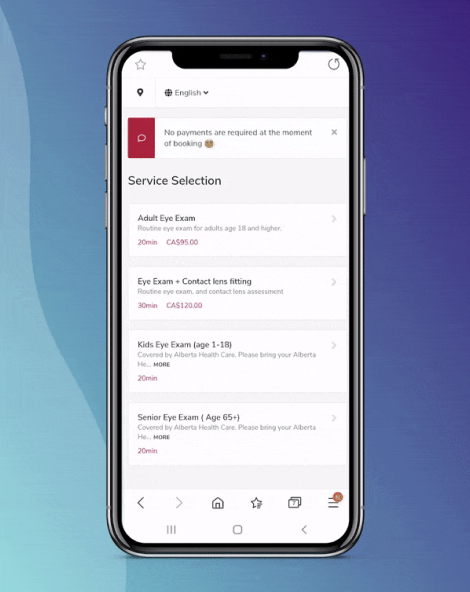
If your prescription is more than a couple of years old, sort that first — a frame decision made against an out-of-date prescription is a guess. Appointments are available at see.charmoptical.ca, and a comprehensive adult eye exam is $99 when it is not covered by AHCIP. If you are replacing lenses in a hurry, ask about same-day glasses when you come in.
FAQ
What do the numbers 52-18-140 on glasses mean?
They are three measurements in millimetres, taken with the boxing system defined in ISO 8624. 52 is the eye size, the horizontal width of one lens opening. 18 is the bridge, the gap between the two lenses over your nose. 140 is the temple length, measured from the hinge to the tip of the arm.
Where are the numbers stamped on glasses frames?
Usually on the inside of one temple arm. All About Vision notes they “usually appear on the inner surface of one of the frame temples that hold your glasses in place behind your ears.” On rimless and some thin metal frames the numbers sit on the bridge instead, and on well-worn acetate frames the print often rubs away.
Is my PD part of my glasses prescription?
No. Pupillary distance is a dispensing measurement rather than a refraction result. WebMD puts it plainly: your provider “normally measures it for you, but you won’t find it on your prescription.” It is used to centre each lens over your pupil, which is why an optician takes it at the point you choose a frame.
Does a bigger frame make my lenses thicker?
With a strong prescription, yes. The sag at the rim of a lens grows with the square of its half-width, so a 56 mm eye size carries about 16% more rim sag than a 52 mm eye size at the same power and index. A wide frame on a narrow face also forces the lens to be decentred, which thickens the outer edge further.
How do I find a new frame that fits like my old one?
Match the sum of the first two numbers, not each number on its own. Eye size plus bridge gives the frame PD, and that is what decides where each lens has to be centred. A 52-18 frame and a 54-16 frame both have a 70 mm frame PD, so they centre the same way even though the lenses are different widths.
What if there are no numbers stamped inside my glasses?
Measure the frame with a millimetre ruler. Take the widest horizontal span of one lens opening for the eye size, the narrowest gap between the two lenses for the bridge, and the hinge to the end of the arm for the temple length. That gets you within about a millimetre, which is close enough to shop with.
What is a normal frame size for an adult?
All About Vision reports that most frames have an eye size of 40 to 60 mm, a bridge of 14 to 24 mm, and a temple length of 120 to 150 mm. A 52-18-140 frame sits mid-range on all three measurements, which is why that stamp turns up so often.
Can Charm Optical measure my frame and my PD?
Yes. Bring your current glasses to 5035 Ellerslie Rd SW in south Edmonton and our team will read the frame numbers, measure your pupillary distance, and tell you which frame widths suit your prescription. Call (780) 490-0090 first if you would like to check our hours.
Come in with the pair you already wear
Two minutes at the counter beats an hour of guessing online.
Hand us your current glasses. We read the stamp, measure your PD, and show you the frames whose numbers actually suit your prescription — including the ones that will keep a strong lens thin.
Charm Optical
5035 Ellerslie Rd SW, Edmonton, AB
(780) 490-0090
Directions & hours Call (780) 490-0090
Eye exams are by appointment — book at see.charmoptical.ca. A comprehensive adult exam is $99 when AHCIP does not cover it.